Tuesday, May 19, 2009

A Shavuot Custom That’s a Cut Above the Rest


Many of us have seen a lot of papercuts in the form of a Mizrach or Ketubah hanging on walls in Jewish homes. Papercutting is not something new to Jewish life. It began in the Middle Ages when in 1345 Rabbi Shem-Tov ben Yitzhak ben Ardutiel’s ink froze while he was writing a manuscript. A resourceful fellow, he did the next best thing – cut the letters into the paper. Around the 17th century, papercutting became a popular form for small religious artifacts like mizrachs, and guess what – Shavuot decorations too! By the 18th century, Eastern European Cheder and Yeshiva students were creating intricate lace patterns of flowers that they called Shavuoslekh (little Shavuot) which they displayed in the windows of their homes.

If you’re looking for a creative Shavuot classroom activity, this is it! Of course, no one expects you to come up with an intricate Shavuot papercut like the one above that I found on Google Images.

Try adapting these snowflake papercut instructions by transforming the flakes into flowers. Don’t wrinkle your nose and tell me to cut it out – you can do it!

Speaking of cutting it out, I know I can be a nudge, but don't forget to take advantage of this exclusive offer for TAMI LEHMAN-WILZIG KIDS BOOKS readers. Kar-Ben Publishing is offering 10% off your next order at their online bookstore. Use coupon code TAMI when checking out. Offer expires August 10, 2009. One use per customer. Offer not valid with any other discounts.

That's all the cutting up for now.
Have a Chag Sameach...Tami

Wednesday, May 13, 2009

Shavuot & Jewish American Heritage Month


Let’s put customs aside this time and focus on history. An article appearing in today’s Jerusalem Post reports how President Obama praised Jewish American Heritage Month -- a May event for the past three years. Having recently visited the Touro Synagogue in Newport, Rhode Island, my curiosity was immediately piqued: could there be some type of historic event connected to Shavuot?

Surf, Google and ye shall find… sure enough, on May 28, 1773, Rabbi Raphael Chayyim Isaac Carregal of Hebron (pictured above along with the poster announcing his sermon) gave a Shavuot sermon at the Touro Synagogue that attracted the attention of Reverend Ezra Stiles, who was Minister of the Second Congregational Church of Newport, Rhode Island. Reverend Stiles eventually became President of Yale University. This was not the first time that Reverend Stiles went out of his way to hear the visiting Rabbi. In fact, the two became close friends.

Ask your students to become detectives. Find out what these two close friends talked about. What important words are found on Yale University’s seal? Is there a connection to Rabbi Carregal? Is there a connection between all of this and President Obama’s reflection that “Jewish American history demonstrates how America's diversity enriches and strengthens us all.”

Speaking of President Obama, in his proclamation he also notes that the Jewish American community has demonstrated that “Americans can choose to maintain cultural traditions while honoring the principles and beliefs that bind them together as Americans.” That brings me back to holiday customs. I’ll see you next week with one more quick and fun Shavuot custom you can do in the classroom.

Le’Hitraot…Tami

Wednesday, May 6, 2009

Shavuot Is The Original GREEN Holiday

One of the customs associated with Shavuot is decorating the synagogue with branches and leaves. I remember when I was a child my father applied this custom in our home, adorning framed artwork with branched leaves during the two-day holiday. There are several reasons we do this: among the holiday’s many names are Yom ha-Bikkurim – the day of the first fruits, and Hag ha-Katsir – the harvest holiday. Some Biblical commentaries add an additional twist to this custom. Since another name for Shavuot is Zman Matan Tora'teinu – the time we received the Torah (actually the 10 commandments) – it’s our way of remembering that the Torah was given to Moshe on Mount Sinai, a mountain with greenery. Another explanation is that baby Moses was hidden among the river reeds and we recall the way he was saved by using greenery for decoration.

A more relevant 21st century reason is that Shavuot was the original GREEN holiday. We read about our ecology-minded ancestors every year in the Book of Ruth. It is Ruth’s idea to glean the leftovers. One of Boaz’s servants explains to Boaz that Ruth is the Moabite woman who returned with Naomi and requested: “I pray you, let me glean and gather after the reapers among the sheaves." While the story then revolves around Boaz’s kindness to Ruth, beyond the message of tzedaka and helping one’s kinsmen, there is another lesson to be learned. Are the leftovers in the field Grade B harvest? Not at all! They are simply grain that has not been collected during harvest time. Both Ruth and Boaz understand that the grain should not go to waste.

Can we create a contemporary custom for this holiday? Absolutely. Just look to the Jewish Community Day School of Rhode Island (JCDS). When we first came to Providence this year I read about an edible garden using a mixture of store bought and composted soil being planted at this school under the supervision of fifth grade teacher, Mrs. Jamie Woods. In an article published by the Jewish Voice and Herald, Mrs. Woods explained that “Judaism teaches us to be shomrei adama, guardians of the earth.” Mrs. Woods continued by elaborating on a very important Jewish law: “Bal tash’hit, which means not to destroy, is the concept that teaches us not to be wasteful, but to protect our natural resources. The establishment of an edible school garden has been a vision of mine for more than a decade…With the help of a dedicated garden team made up of teachers, parents and community members, the JCDS edible garden will become a reality this spring.”

What perfect timing for Shavuot – the original Bal tash’hit holiday. Planting a garden in the Fall so that students will harvest its produce in the Spring, making sure nothing goes to waste. Ruth and Boaz would be proud. It’s something for all of us to think about come next year. In the meantime, this year plant the seeds of this idea by discussing it with your students so that they will be ready to take part in a new Shavuot custom. As for Mrs. Woods and the JCDS, all I can say is Kol Ha’Kavod and Todah Rabah.

See you soon with more existing customs and new custom ideas.In the meantime, don’t forget to take advantage of this exclusive offer for Tami Lehman-Wilzig Kids Books readers. Go to Kar-Ben Publishing’s online bookstore and get 10% off your next order. Use coupon code TAMI when checking out. Offer expires August 10, 2009. One use per customer. Offer not valid with any other discounts.

Chag Sameach

Tuesday, April 28, 2009

Yom Ha’Atzmaut with the Author


This past Sunday I had the privilege of participating in a live video “Q&A with the Author.” These twelve 5th graders attending the Congregation Har Shalom Religious School located in Fort Collins, Colorado, appeared on my computer screen (and I on theirs) in order to engage in a pre-Yom Ha’Atazmaut celebration that entailed asking an Israeli-American children’s author why she moved to Israel 31 years ago, what she likes the most about Israel, which holiday she likes celebrating the most, plus a host of other well thought-out questions dealing with life in Israel, as well as my writing. This live electronic event was one of the more memorable episodes of my sabbatical year here in the States and it has prompted me to create my own Yom Ha’Atzmaut custom. From now on I will do up to five live “Q&A with the Author” on life in Israel during the days around Yom Ha’Atzmaut.

Perhaps it’s the Shaliach inside of me, but when school librarian Judy Peterson (pictured here with the class) told me how hard it is to get kids to connect with Israel, I spontaneously suggested we hold this live meeting using Skype. The truth is she wasn’t the first to express this concern. I’ve been hearing it all year, wherever I go. This time around I instinctively felt that a small school so far away deserved attention. I was right. Here’s what Judy emailed me later that day:

Hi Tami,
It was such a pleasure to meet you "face to face" today! The kids really enjoyed the conversation, as did I. You answered their questions so thoughtfully and fully and really gave them some things to think about. I hope you enjoyed the conversation as well and that it gave you an idea of what kind of misperceptions these kids have about Israel.
It's so wonderful when we can employ modern technology in the education of our children, and for our kids to "meet" good Jewish role models such as yourself. If you’re willing, maybe we can do something similar again next year.
Best regards…Judy Petersen


I’ve already told Judy that she’s on for next year. There will be new fifth graders with new questions about Israel. If you’re interested in helping me get this custom more widespread contact me:tami@tlwkidsbooks.com

In the meantime, Chag Sameach….Tami

Tuesday, April 21, 2009

Celebrating Independence


As I mentioned in my last blog, we have now entered the “Freedom & Remember” season. When it comes to Independence Day, Israel does it back-to-back. Fallen soldiers are honored on Memorial Day, which like Yom Ha’shoah is marked with sirens and on-the-spot, standstill attention. In typical Jewish time, as soon as the sun sets uncontrollable happiness breaks loose over having an independent state.

We all know that Israelis are openly expressive. They show off their joy through some goofy customs – like hitting people on the head with a plastic hammer, or squirting their neighbors’ faces with shaving cream. But, they do have another side connecting today with the Jewish yesteryear of long ago.

Like what? Here are two examples you might want to adapt to your classroom:

• On cue, all Israelis take part in a Yom Ha’atzma’ut barbeque. “Big deal,” you’re saying to yourself, “Americans do that too on July 4th.” So here’s the BIG DEAL connecting Israelis with yesteryear. Remember all those Temple sacrifices that the Israelites offered for every holiday? While modern Israelis don’t engage in that ritual, barbequing fresh meat on Yom Ha’Atzma’ut can be viewed as the contemporary way of expressing thanks for having a modern Jewish State.
This is literally food for thought for you and your students. Have the cooks in your kitchen, or your PTA, grill some hamburgers and hotdogs and serve them alongside Israeli salads that the students can help prepare. Need some recipes? I found these variations of the classic Israeli salad:

• Another custom that bonds modern Israelis with their past is the annual televised Bible Quiz held on Independence Day. This is a VERY BIG DEAL, as the contestants are not only from Israel – they are young students from all over the world. So here’s another idea: hold your own Bible quiz and connect it with today’s modern Jewish State. How? Let’s say you ask a question dealing with King David. Have a map and picture presentation ready to show where the City of David is located and what it looks like today. You can do this with dozens of Biblical events and personalities. Let the Bible stories they’re learning about come alive through a virtual tour.

Customs aside, throughout this year I have been told by numerous teachers, librarians and parents that it is getting harder and harder to connect kids with Israel. They feel it’s a dangerous place. They have a good life in America and they don’t understand why they have to worry about having a Jewish State. There are numerous answers, but I’ll just give you a few.
• Dangerous? Yes, I’ll agree that Israel is not located in the best of neighborhoods and terror is a threat. HOWEVER, throughout our 31 years living in Israel I don’t ever recall any Israelis going on crazy shooting rampages in schools or public places. Even better, by the time my kids were 5 years old they were going to the local grocery by themselves, sent there by me with a short shopping list. From first grade on, once they finished their homework I never saw them until suppertime because they were outside with their friends, playing without any adult supervision. Did I worry? Not at all.
• The Good Life: We’ve got it as well. The country is dotted with malls, country clubs, and all types of entertainment venues – from movies to extreme sports. Plus, we have all the technology you have. In fact, you can thank us for some of that technology. Pass this on to your students: thanks to Israel, you have mobile phones and you text message on them. “WHAT???!!” you’re asking. That’s right, “Made in Israel.” And that’s just a tiny example of what Israel has given the world.
• One BIG Mishpacha: Israelis certainly don’t behave like Americans. More like relatives who never hesitate to tell you what to wear, what to eat, why you should do this or that. And that is exactly the point. We are all one BIG mishpacha – family. You don’t need a direct blood link in Israel to feel like family. The warmth and hospitality is overwhelming…and if you need help, let me assure you that you will never feel at a loss.

I could go on (most Israelis tend to do that). But I’ll stop here and with unbridled pride wish you a Chag Atzma’ut Sa’me’ach!

Friday, April 17, 2009

What You Can Do for Yom HaShoa – Holocaust Memorial Day


Yom HaShoa – Holocaust Memorial Day – is neatly tucked in between the last day of Passover and Israel’s Memorial/Independence Day celebrations. I call it Jewish precision planning, revolving around the Jewish mantra “REMEMBER.” Remember that we were once slaves in Egypt. Remember that the Nazis tried to destroy us.

In Israel it’s a lot easier to remember. Like clockwork at 10 a.m., air raid sirens blare forth for two minutes. The whole country literally comes to a standstill. Schoolchildren stand at attention next to their desks. Even cars on the highway brake to a halt; drivers get out and solemnly stand still on the road.

You could try simulating a moment of silence in your classroom and school. Better yet, Yom HaShoa is a wonderful opportunity to read a relevant book to your students. With today’s elementary school students being third and fourth generations away from the Holocaust, they don’t share the same emotions we did at their age. It is our job to connect them with this major event in the not so distant past that almost destroyed most of the Jewish world.

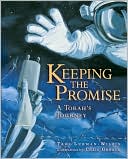
I have been doing interactive presentations on my book Keeping The Promise ever since it came out in 2003. The photo above is the beautiful display created by Elayna Weisel, the librarian at The Rose and Jack Orloff Central Agency for Jewish Education of Broward County, who arranged a wonderful author's tour for me this past November. Presenting Keeping The Promise was part of that tour. I can tell you that kids are spellbound by Holocaust stories. Whenever I finish reading this timeless tale of a Bar Mitzvah secretly celebrated in the Bergen-Belsen concentration camp I always get the same response from every group of students. First they applaud and then they immediately ask: “Is that a true story?” I have yet to do a presentation on this book where this question is not asked, and right away. That says something. Kids want to connect. They want to feel that there is a direct link between their Jewish history and where they are today. Once I answer “yes”, inevitably there is always one student who gets the ball rolling by stating: “my grandmother/father (or great-grandmother/father) escaped the Nazis”. Then the discussion begins.

There are so many wonderful, true Holocaust stories for children. Pick the one you feel best suited for your class and give it your all when you read it out loud. The sirens don’t have to blare to get them to be quiet. You will appreciate the sounds of silence in your room as your students absorb every detail.

If you’d like to find out more about my book Keeping The Promise please visit my website and click on the book tour section.

I’ll be back next week with some Yom Ha’Atzmaut customs from Israel. In the meantime, don’t forget to take advantage of this exclusive offer for TAMI LEHMAN-WILZIG KIDS BOOKS readers. Go to Kar-Ben Publishing’s online bookstore and get 10% off your next order. Use coupon code TAMI when checking out. Offer expires August 10, 2009. One use per customer. Offer not valid with any other discounts.

Tuesday, March 31, 2009

LET THE PASSOVER FUN CONTINUE

After the Seder, then what?
Yes, the Seder is the main event, but we don’t want children to lose sight of the Passover message after the Seder is over. How can we get across the concept of freedom during Hol Hamoed, or if we want to stretch it, on the first day of school after the Passover vacation?

Here’s a quick, cute and fun way. It’s one of the most creative Passover customs that I’ve come across. On the 7th night of Passover the Ger Hassidim in Jerusalem get together in their shteibel (small synagogue) to reenact the crossing of the Red Sea. They throw a barrel of water on the floor, lift up their long coats and “wade” through the water, calling out the different names of towns on the way to Ger. In contemporary kid terms, they create their own mini water park. What and how you do it in your class or at home, are up to you. One thing is certain: it will be a splash!

Chag Sameach.
Have a wonderful and meaningful Passover.