Yes, you've dipped apple slices in honey on Rosh Hashanah. Yes, you've decorated your Sukkah with hanging fruits. But fruits as part of the Hakafot on Simhat Torah? Ask Jews of Afghani descent and they'll tell you exactly what to do.
Go to the market the day before Simchat Torah and buy the choicest fruits you can find. Wrap them in silver or gold foil, so that they resemble sweet candies. Place the wrapped fruits around Elijah's chair.
Elijah's Chair? That's right. The same chair normally associated with a Brit Milah is the Afghani focal point for the seven Hakafot. A single Torah scroll is placed on the chair and the Hakafot are performed around it. And the fruit? They are considered "privileged" to be part of the Hakafot. In fact, so special that at the end of Simhat Torah they are auctioned off for considerable sums.
Hmm...that's a new slant on fundraising. Is there a way it can be translated into a classroom setting? I think so. Just like you have a model Seder before Passover, hold model Hakafot using luscious, wrapped fruits for accessories. Have enough for a mid-morning or mid-day snack. Connect each piece of fruit with an act of Tzedakah, and "auction" it off so that the student "winning" the piece of fruit promises to perform the good deed and report about it in class.
Two for the price of one -- Simhat Torah and Jewish values. A lesson plan that truly bears fruit.
Chag Sameach.
Photo Credit
Tuesday, October 2, 2012
Thursday, September 27, 2012
Lulav Customs Connecting Sukkot with Passover
Finding customs that connect one holiday to another has become a favorite activity for me. You may remember the wonderful Italian custom I discovered linking Tisha B'Av with Hanukkah. This time, a little sleuthing has led me to a lulav custom that connects Sukkot with Passover. I'll make it short and sweet. Syrian, Moroccan and Baghdadi Jews put the lulav away after Sukkot and take it out erev Pessach to burn the Chametz.
Yemenite Jews save the entire package -- lulav, aravim and hadassim -- and use it as oven fuel for baking shemurah matzot.
What's the logic behind these customs? They are based on the Talmudic principle (Berakhot 39b and Shabbat 117b) of reusing an item that was employed for one mitzvah to do another one. Hey -- doesn't that sound like today's "reuse and recycle"?
Finally, here's another wrinkle I found last week: save the lulav and use it as the broom for getting the chametz out of your home (and classroom). Remember, it has a sharp tip, making it easy to get into the corners. Plus, you know what they say about new brooms -- they make a clean sweep.
Chag Sameach.
Yemenite Jews save the entire package -- lulav, aravim and hadassim -- and use it as oven fuel for baking shemurah matzot.
What's the logic behind these customs? They are based on the Talmudic principle (Berakhot 39b and Shabbat 117b) of reusing an item that was employed for one mitzvah to do another one. Hey -- doesn't that sound like today's "reuse and recycle"?
Finally, here's another wrinkle I found last week: save the lulav and use it as the broom for getting the chametz out of your home (and classroom). Remember, it has a sharp tip, making it easy to get into the corners. Plus, you know what they say about new brooms -- they make a clean sweep.
Chag Sameach.
Lulav Photo Credit
Sunday, September 23, 2012
Green Sukkah, Iraqi Style
Dried vegetation for building a sukkah? It certainly looks like the raw material used for creating this part of a Sukkah entitled Fractured Bubble -- one of the winning entries at New York's 2010 Sukkah City (click on the link to see the entire Sukkah).
My question is -- did the creator of this installation have Iraqi roots (pun intended)? I ask because during my recent research on Sukkot customs I found a photo of a Sukkah in Shanghai, China, circa 1930, built by the president of the Baghdadi community. Following the custom of Jewish community leaders in Baghdad, this Sukkah was made from branches of local vegetation -- not just the sechach (roof covering), but all four walls.
I have no idea if they used fresh or dried vegetation, but let's assume it was the latter and connect it with today's environmental mantra of reduce, reuse and recycle. Using dried up vegetation is a wonderful way to create a green sukkah. Agreed, it may be A LOT of hard work, so here's my suggestion. This year make a miniature prototype. If you live in a house, check out your hedges and backyard greenery. Instead of throwing weeds, dried up leaves and branches away, connect them green lego style. Live in an apartment? How about taking a trip to your local florist and ask what they do with unsold, wilted flowers. Those stems can be easily recycled. Other ideas? I think I'm going to let you take it from here. Think green and out of the box. I'm sure you and your children/students will come up with more innovative sukkah building ideas.
My question is -- did the creator of this installation have Iraqi roots (pun intended)? I ask because during my recent research on Sukkot customs I found a photo of a Sukkah in Shanghai, China, circa 1930, built by the president of the Baghdadi community. Following the custom of Jewish community leaders in Baghdad, this Sukkah was made from branches of local vegetation -- not just the sechach (roof covering), but all four walls.
I have no idea if they used fresh or dried vegetation, but let's assume it was the latter and connect it with today's environmental mantra of reduce, reuse and recycle. Using dried up vegetation is a wonderful way to create a green sukkah. Agreed, it may be A LOT of hard work, so here's my suggestion. This year make a miniature prototype. If you live in a house, check out your hedges and backyard greenery. Instead of throwing weeds, dried up leaves and branches away, connect them green lego style. Live in an apartment? How about taking a trip to your local florist and ask what they do with unsold, wilted flowers. Those stems can be easily recycled. Other ideas? I think I'm going to let you take it from here. Think green and out of the box. I'm sure you and your children/students will come up with more innovative sukkah building ideas.
Wednesday, September 19, 2012
Connecting Kol Nidre with Bullying
In other words, listen up bullies: despite your actions we are still open to accepting you in our midst. How? Perhaps by showing bullies that Rosh Hashanah-Yom Kippur is a time to examine one's deeds and understand what motivates one's behavior. Once they do that, hopefully they will stop the taunting and be ready to sit by our side on Kol Nidre.
Gmar Hatima Tova.
Sign credit
Sunday, September 2, 2012
Lithuanian Jews Combine a Rosh Hashanah Custom with a Hebrew Lesson
Who hasn't heard of the carrot and stick approach for learning or eating sweet carrot tzimmes for Rosh Hashanah? But eating plain carrots on Rosh Hashanah because of its Hebrew term? Yup that's the creative approach of Lithuanian Jews. They eat sliced carrots because the Hebrew word for carrot is gezer and on Rosh Hashanah we pray for good gezerot -- decrees.
I bet you're saying that's a stretch. Still, this out-of-the-box custom got me thinking. Maybe they're on to something. Maybe this is a good way of getting kids to enjoy their Hebrew lessons.
Here's the next Rosh Hashanah veggie connection that I thought of.
Explain the Tashlich custom by offering your children and students celery sticks. Selek is the Hebrew term for celery and our aim at Tashlich is to le'salek -- throw away our sins.
Food for thought? Let's face it, in the crunch our aim is to make our Jewish heritage palatable and fun.
Carrot photo credit
Celery photo credit
I bet you're saying that's a stretch. Still, this out-of-the-box custom got me thinking. Maybe they're on to something. Maybe this is a good way of getting kids to enjoy their Hebrew lessons.
Here's the next Rosh Hashanah veggie connection that I thought of.
Explain the Tashlich custom by offering your children and students celery sticks. Selek is the Hebrew term for celery and our aim at Tashlich is to le'salek -- throw away our sins.
Food for thought? Let's face it, in the crunch our aim is to make our Jewish heritage palatable and fun.
Carrot photo credit
Celery photo credit
Sunday, August 26, 2012
21st Century Learning Collaboration Opportunity
Education
is taking a new, interactive technological turn and I'm excited about
it. So excited, I want to be a part of it. That's why I would like to
engage you in a unique 21st
century learning collaboration, using some of my books as a way to
integrate multiple disciplines with an unusual, virtual author visit.
I'll
give you an example. Take the holidays of Hanukkah and Passover. Your
curriculum calls for teaching why and how these festivals are
celebrated. I can breathe new life into your teachers' lesson plans
through my books Hanukkah
Around the World and Passover Around the World. These books consist
of original stories revolving around unusual holiday customs from
countries across the globe. Each story is accompanied by brief
background information on the Jewish community of a specific country.
That means we have four subjects wrapped in one book: Jewish history,
geography, Hanukkah/Passover customs and background information, PLUS
literature.
Now
for the FULL PACKAGE. I have developed interactive PowerPoint
presentations around each book. By working out all details and using
your school's smart technology, I can enhance your school's learning
experience through a 50-60 minute virtual author visit and program.
I
have other books that lend themselves to these visits as well. Try a
new twist in teaching Bible stories through my two books Tasty
Bible Stories
and Green Bible Stories for Children – the latter being perfect for
teaching about the environment or creating a unique Tu B'Shvat
program.
What
better idea for a grandparent program than one of my two Jewish
Heirloom Stories – Mayer
Aaron Levy and His Lemon Tree or Lotty's Lace Tablecloth?
Your
students can participate in my programs, read stories together with
me, and then engage in a Q&A with the author. Each presentation
is limited to 30 students. Fees for single and multiple presentations can be worked out with me.
To
find out more about my books, please visit my website. It's
friendly and easy to navigate. Afterwards, contact me through my website so that we can continue the conversation (email or Skype) and
work together on how to strategically replace learning materials for
the specific subjects my books deal with.
Looking
forward to hearing from you.
Kol
Tuv...Tami
Friday, August 10, 2012
In Poland the "Shulklapper" Hammered Home the Message of the Month of Elul
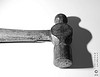
Back when there were no alarm clocks (remember them?) Jews in Poland relied on the gabbai's Shulklapper to wake them up for the Selichot prayers.
What exactly was this instrument used to klap -- knock -- on the door in order to make sure everyone got to shul -- synagogue -- on time?
Nothing more than a hammer for hammering home the message "it's time to get up and pray."
The connection to today? While we no longer knock messages into our children's heads, the underlying beauty of Rosh Hashana and its preceding days should be gently conveyed. Rosh Hashana is much more than an occasion to eat, drink and be merry. The Jewish New Year is a time for contemplation, a time to review what we've done wrong and how we can better ourselves.
Want a more practical, hard hitting message? How about a real-time wake-up call? The school year is just is around the corner. Kids rely on the pleasing alarm tones of their mobile phones to wake them up. Will that be enough after the long summer break? It's hard to get back into an early morning routine. Perhaps a little "klap" on the door will help?
Synagogue Photo Credit
Hammer photo credit
Subscribe to:
Posts (Atom)