Sunday, March 25, 2012

Bring the Custom of "Kimcha d'Pischa" to Your Seder Table


This week I'm going to put fun Passover customs to the side and focus on a more serious tradition --  Kimcha d'Pischa.


This ancient custom is traced to the Jerusalem Talmud. Its literal meaning is "flour for Passover", which is exactly what the Rabbis instructed fellow Jews to give the poor who had no means of baking their own matzot.

Today, Kimcha d'Pischa has evolved into food packages for the needy. Certainly, this is an admirable form of charity and a wonderful way to get children involved in helping the poor. Yet, you don't have to be penniless to be poor. Assistance to the needy does not begin and end with food or money. My late father began a custom in our family, which I continue to this day. At the end of synagogue services on the first and second nights of Passover, he rounded up the lonely and brought them home to sit around our Seder table. My hat goes off to my late mother who never made a fuss. Equal credit goes to my entire family, including aunts, uncles and cousins who warmly welcomed the strangers sitting next to them.

My family was not alone in this generous act. While researching Kimcha d'Pischa I found a family in Poland who did the exact same thing. I'm sure that if I made the effort, I would find others as well. Tying this tradition to the actual Seder night is easy.  You are told to pass down the story about the birth of our nation to your children. The hagaddah reminds us that we were strangers in Egypt. Connect the dots, bring strangers to your table and pass down an expanded Kimcha d'Pischa custom that will give added meaning to your seder nights and the lives of your guests.


Flour photo credit

Sunday, March 11, 2012

Combine Passover Customs from Tunisia, Yemen and Turkey for a Unique Model Seder

It's that time of the year again. Time to make seder -- which literally means "order" in Hebrew. This year try a new world order by combining customs from 3 countries. It's a thinking-out-of-the-box suggestion and I promise it will engage your children and students.

Start your Passover tour by going to Tunisia with a custom that I brought up last year -- sitting on mattresses. They're comfortable, definitely have reclining space, and yes, they make the experience a lot more authentic for children.

Next stop: Yemen. Forget about the seder plate. They have a seder table, meaning they place all the symbols on the table itself. I suggest you use either very low tables or the floor. Put down a tablecloth and arrange the Passover food symbols on all four corners and/or in the middle.  Make it plentiful, yummy and colorful, with an aroma that can't be beat.

Final destination: Turkey. Jews living in this Western Asian country follow the wonderful Sephardic custom of beginning the Seder with a play. I always bring up this custom because it's my favorite. It has the Purim costume element with a family member dressing up as one of the Children of Israel. S/he conducts a short dialog with the seder leader by answering the questions: "Who are you?" "But I thought you are a slave, where are you going?" "What was it like in Egypt?"

Get the picture? A homespun, down to earth approach in this day and age of ready made props and video clips.

Enjoy! I'll be back with more Passover customs.

Photo credit


Sunday, February 26, 2012

This Purim Step, Stomp & Walk Tall

Back in the 1960's Nancy Sinatra made it big on the music scene thanks to her hit These Boots Are Made For Walking and its popular refrain: One of these days these boots are going to walk all over you.

Did she have Haman in mind when she sang this song? Sure enough one of the Purim customs I recently found is to write the name of Haman on the sole of your shoes, and stamp your feet really hard every time Haman's name is called out during the Megillah reading until his name is erased. Unfortunately, this custom was not connected to a specific country but it did remind me of a French Purim custom that I posted in 2010 in which Haman's name was either printed or engraved on 2 stones knocked together during the Megillah reading.

Contact me if you have any other creative customs for obliterating Haman's name. I'll be happy to post them.

Purim Sameach. Happy Purim.


Photo credit

Sunday, February 12, 2012

A Purely Persian Purim

Meet Queen Esther. At least that's who I'd like to think this lady is, for who else would be depicted on a 17th century tile made in Isfahan, Iran, depicting an Iranian Jewess?

I have been fascinated by Iranian Jewry for over eight years -- from the moment I discovered Esther and Mordechai's mausoleum while surfing the net. It is located in the Iranian city of Hamadan, also famous for its Persian carpets. The  minute I landed on this Jewish tourist site I began to look at Purim in a purely Persian light. No longer did it seem a mythical tale meant for a carnival celebration. So serious is this holiday that most Jews living in Iran -- secular and religious alike -- observe the Fast of Esther. Nothing is closer to home for them than Purim, with Esther and Mordechai part of their persona.

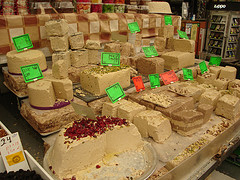
You can imagine the culture shock Iranian Jews experienced after the 1979 revolution, when many sought safety in the United States and Purim rolled around. Little of what they witnessed was recognizable. Costumes? Certainly NOT a Persian custom. Same for Mardi Gras type merrymaking. Drowning out the name of Haman during the megillah reading through a cacophony of noise? Yes, but only one of their Haman traditions. While hanging effigies of Haman in backyards and burning them was no longer widespread (I assume for reasons of political correctness), some families wrote and sang their own songs about the insidious villain. Haman aside, giving children gifts and coins was a commonplace tradition, providing Purim with an atmosphere we associate with Hanukkah. Finally, Mishloach Manot came in only one form, and it wasn't a basket full of goodies. Homemade halva (much like these Israeli varieties) presented on a plate was the Persian preference, and the most widespread symbol of Purim.


Today, Iranian Jews have successfully assimilated into the American way of life, leaving "the old country" and much of its ways behind. Last year I met a group of American-Iranian Jewish teens studying in Israel. Sadly, they barely knew about these traditions.  How unfortunate in this multi-cultural age.

Hopefully this post will help bring Persia back into Purim. To make it even more authentic, take your students and children on this virtual tour of Esther and Mordechai's mausoleum. Like Jerusalem's Western Wall, it was the place Iranian Jews went to pray, cry and make special requests.

Enjoy your Persian Purim. Make it meaningful and merry at the same time.

Tile photo credit
Halva photo credit

Sunday, January 29, 2012

Many Generations Back Jews Living in Jerusalem's Old City Gave Each Other Mishloach Manot on Tu B'Shvat

One of the things I love about writing this blog is discovering how customs normally associated with one holiday have been adapted by different Jewish communities to another. Take the Purim practice of giving Mishloach Manot.  Who would think that this custom would apply to Tu B'Shvat? A seventh generation Israeli whose forebears originally lived in Jerusalem's Old City reports that way back when in the Jewish Quarter, people sent trays filled with fruits, nuts and seeds to one another.

I can only give an educated guess as to why. There has been a continual Jewish presence in Jerusalem's Jewish Quarter since the 8th Century BCE. The Tu B'Shvat Seder dates (forgive the pun) back to the 17th century. The term Mishloach Manot literally means "sending portions" -- ensuring that everyone has enough food for the feast. Let's connect the dots. Seven generations back leads us to somewhere in the mid-19th century. Jews living in Jerusalem back then were not exactly wealthy. In all probability, they observed the ritual of a Tu B'Shvat Seder. But what if they didn't have enough money for fruits and seeds? Aha! Mishloach Manot, of course.

As I said, it's only a hunch, but there's no guesswork as to what fruits are eaten on Tu B'Shvat. All you have to do is bite into 5 of the 7 Species: grapes, figs, pomegranates, olives and dates are all native to Israel. I say let's expand the list and teach our children about other fruits Israel is famous for (I know that Zvuvi has provided you with the latest innovation).

Let's start with prickly pears, commonly known in Israel as the Sabra fruit. Yes, it's the best way to explain the Israeli personality -- tough and thorny on the outside, sweet and soft on the inside. Please don't forget lovable and loyal.


Need another juicy Israeli fruit tidbit? Try our oranges.
I know that oranges and Florida are synonymous to you, but Israel put oranges on the European market map with its famous Jaffa brand. When Spain and Portugal started to heat up the competition, we branched out by developing unusual citrus varieties.

Finally, how about a new Pitaya hybrid Made in Israel?


Have I helped you make seder -- order -- about fruits for Tu B'Shvat? I hope so. Happy New Tree Year. Enjoy all the fruit that they bear.


Dried Fruit & Nuts Photo Credit
Prickly Pear Photo Credit
Oranges Photo Credit
Pitaya Photo Credit

Tuesday, January 17, 2012

Virtual Author Visits for Passover, Yom HaShoah and Yom Ha'Atzmaut


Shalom from Israel:
Yes, that's me on a smart board at the Talmud Torah of St. Paul where I had a wonderful virtual author visit on January 9th. In fact, I've conducted several virtual author visits recently, and have found them to be a fun and enriching experience for the students and myself. My latest one was at the Religious School of Houston's Temple Sinai, during which I read Keeping The Promise, followed by a short Q&A.

This visit led me to an aha moment. Passover, Yom Hashoah and Yom Ha'Atzmaut are coming up and I have a book for each one:


Why not "invite" me to your school? Virtual Visits have numerous benefits: They create a sense of excitement, they're part of today's new technology, they eliminate the bother of transporting an author to your school, and most important for today's economy, they are the budget-wise way for creating an enrichment program. For more details, please visit my website.

Looking forward to hearing from you and meeting your students this Spring.

Le'Hitraot...Tami

Sunday, January 15, 2012

Iraqi Jews Connect Weddings with Tu B'shvat

Once upon a time Jews living in the Land of Israel planted trees for babies born the previous year. Cedar trees were earmarked for boys, ensuring the infants develop into  tall, upright citizens. Girls on the other hand were assigned cyprus trees because of their grace and fragrance. On wedding days these two trees intertwined, with branches from both used to make the huppah, wedding canopy -- a theme continued on modern-day huppot.

But what about the actual connection between Tu B'Shvat, trees and weddings? Ask Iraqi Jews who call this holiday Chag Livluv HaEtzim -- Holiday of Tree Blossoming. One of their special customs is taking the bachelorettes of their community to the forest and assigning a tree to each as a "husband." One month later they return to the forest, checking which trees have begun to blossom. These symbols of budding romances mark upcoming marriages during the coming year.

You can say this custom is quaint or sweet, but let's put it in today's ecological terms. After all, Tu B'Shvat is the original Arbor Day and by Iraqi Jewish lights one could say that in order to protect the environment, they wisely husband their energy.


Photo Credit