Like you, I'm hoping that the extreme weather in the United States will make a turn around, but just in case you experience another snow storm, think about adopting this Bukharan Purim custom
Bukhara is the perfect combination of exotica and history. Located on the ancient Silk Road, this Central Asian city and surrounding region was once home to a vibrant Jewish community.
In fact, this is not the first time I've taken you to Bukhara. Last year I introduced you to the Bukharan Jewish custom of a Passover Seder overture. Sure enough, now I've discovered that this colorful community had a creative Purim twist as well.
There is always snow on the ground in Bukhara when Purim rolls around. While very few Jews remain in Bukhara and its surrounding areas, when this vibrant community was at its peak, they made the most of the snow by sculpting snowHamans like the one in this picture.
I know you're sick of the snow, but just in case you get another dumping, now you can creatively put it to use. I've found 10 snow sculpting tips you might want to follow. If you want to go all the way, think about this: carve Haman's name into his torso, light a candle or two right next to him, watch him melt away and presto! You have a Purim variation of the Wicked Witch of the West.
Snow-Haman Photo Credit
Showing posts with label Purim. Show all posts
Sunday, February 23, 2014
Sunday, February 9, 2014
A Different Purim Twist from Morocco: Haman's Eyes
Haman must have been a funny looking fellow. Ears that looked like triangles, and (now I've discovered) -- eye sockets that looked like unshelled hard boiled eggs.
You guessed it. Two hard boiled eggs in their shells are the key for baking a Moroccan Purim bread called Haman's Eyes. It can be a bread adorned with almonds, like the one in this picture, used as part of the Mishloach Manot.
Or...it could resemble this!
A fun class or home activity? You bet. Just follow this recipe and give that devil everything he deserves!
Photo credit
Haman's Eyes Photo Credit
You guessed it. Two hard boiled eggs in their shells are the key for baking a Moroccan Purim bread called Haman's Eyes. It can be a bread adorned with almonds, like the one in this picture, used as part of the Mishloach Manot.
Or...it could resemble this!
A fun class or home activity? You bet. Just follow this recipe and give that devil everything he deserves!
Photo credit
Haman's Eyes Photo Credit
Sunday, January 19, 2014
What Are You Doing for Rosh Chodesh Adar?
Are you leaping for joy because this year is a leap year on the Jewish calendar? Have you thought about the fact that one week from this coming Friday you can start singing the Doublemint chewing gum song Double Your Pleasure, Double Your Fun...?
Yup. This year we've got the twin Adar months of Adar Aleph and Adar Bet. Since Adar is the happiest month on the Jewish calendar, that means we can double our fun. And since Purim is celebrated during Adar Bet, we have an expanded heads up for planning this joyous celebration.
But first, what do you have planned for Rosh Chodesh Adar Aleph? Don't forget, it's the prelude to your Purim festivities.
Have you thought about a combined Rosh Chodesh-Shabbat feast?
Hmmm...let's play with this idea. Originally Rosh Chodesh was an important monthly holiday. The shofar was blown, followed by family festivities -- meaning yummy food. On Shabbat we welcome the Sabbath Queen with a sumptuous meal. So, a mini Friday/Shabbat-Rosh Chodesh banquet sounds like a natural. Here are some kosher kid-friendly recipe ideas.
Next, let's welcome Rosh Chodesh Adar with a little fanfare. Blow the shofar please.
This is beginning to sound like a royal procession -- which ties in as well since Rosh Chodesh Adar falls on Friday, and on Friday nights we welcome the Sabbath Queen. Before a royal monarch enters a banquet hall trumpets are blown and a royal flag parade precedes the monarch. A flag for this year's Sabbath Rosh Chodesh Adar Queen? With a coat of arms? Have a look at this. Not only will it get you in a Rosh Chodesh Adar celebration mode, but it will also get you thinking about Purim.
All of this is just for starters. The rest is up to you. Remember: It's your Purim rehearsal and the beginning of two joyful, happy, fun months.
Rosh Chodesh Graphic Credit
Shofar Blowing Photo Credit
Thursday, February 14, 2013
Algerian Jews Connect Purim with Hanukkah
It's always fascinating to find out how some Jewish communities around the world connect different holidays through customs. In the past I've written about Jews in Portugal giving Purim "gelt" to their children. Now I've discovered an additional Purim custom connecting this holiday with Hanukkah. Algerian Jews have a custom of children lighting candles on Purim. Unfortunately, I don't know how many but let's assume there's one candle for every major character in the Purim story.
You're probably thinking "Cute, but how can I connect this to classroom or home activities?" Here's the answer. I've googled and there are simple candle making instructions for kids. Create different sizes and colors for each character, light them and watch them burn. I'm placing my bets on a short, red colored candle for Haman with a caption "Burn Baby, Burn."
Sound right to you?
Photo credit
Sunday, January 27, 2013
Origins of the Purim Masquerade Custom

Have you ever wondered when the Purim masquerade custom began?
The honest truth is that it's embedded in the Book of Esther, but we'll get to that later. If we want to stick to global custom origins, the first recorded source of dressing up in costume on Purim is a 15th century German document discussing women wearing men's clothing, drunkenness and other related Purim issues.
Any other global connections? There is a school of thought connecting Purim masquerades with the Carnival of Venice which dates back to the 11th Century. By coincidence, the calendar date of this festival famous for superb leather, porcelain and glass Venetian masks is not all that far from Purim. Hmmm...many Jewish customs have been "borrowed" from Christian neighbors, so this sounds like a definite possibility.
Speculation aside, let's take a look at the Book of Esther -- a story chock full of disguises.
The most obvious example is Queen Esther herself, depicted in this mosaic. Hiding her Jewish identity by competing in and winning Achashverosh's beauty pageant was the biggest masquerade of all. Even the name Esther, possibly taken from the Persian name Ishtar, is part of the cover up. Esther's given Hebrew name? Hadassah -- as in the name of the women's organization.The carnival of poses doesn't end with Esther. Let's take her husband, the mighty king Achashverosh. He wears the mask of a strong ruler when actually his advisors -- most notably Haman -- rule him. Mordechai hides behind the mask of a loving uncle when he really is a mastermind pulling strings in order to save the Jewish people.
Haman? Is he as smart as he presents himself to be? Indeed, the story of Purim is one big charade. Speaking of which, maybe a good old fashioned game of charades should be part of this year's Purim curricula or family Purim feast? Not only does it enhance the masquerade custom, it sets the stage for it.
What do you think?
Mask photo credit
Queen Esther mosaic photo credit
Sunday, February 26, 2012
This Purim Step, Stomp & Walk Tall
Back in the 1960's Nancy Sinatra made it big on the music scene thanks to her hit These Boots Are Made For Walking and its popular refrain: One of these days these boots are going to walk all over you.
Did she have Haman in mind when she sang this song? Sure enough one of the Purim customs I recently found is to write the name of Haman on the sole of your shoes, and stamp your feet really hard every time Haman's name is called out during the Megillah reading until his name is erased. Unfortunately, this custom was not connected to a specific country but it did remind me of a French Purim custom that I posted in 2010 in which Haman's name was either printed or engraved on 2 stones knocked together during the Megillah reading.
Contact me if you have any other creative customs for obliterating Haman's name. I'll be happy to post them.
Purim Sameach. Happy Purim.
Photo credit
Did she have Haman in mind when she sang this song? Sure enough one of the Purim customs I recently found is to write the name of Haman on the sole of your shoes, and stamp your feet really hard every time Haman's name is called out during the Megillah reading until his name is erased. Unfortunately, this custom was not connected to a specific country but it did remind me of a French Purim custom that I posted in 2010 in which Haman's name was either printed or engraved on 2 stones knocked together during the Megillah reading.
Contact me if you have any other creative customs for obliterating Haman's name. I'll be happy to post them.
Purim Sameach. Happy Purim.
Photo credit
Sunday, February 12, 2012
A Purely Persian Purim
Meet Queen Esther. At least that's who I'd like to think this lady is, for who else would be depicted on a 17th century tile made in Isfahan, Iran, depicting an Iranian Jewess?
I have been fascinated by Iranian Jewry for over eight years -- from the moment I discovered Esther and Mordechai's mausoleum while surfing the net. It is located in the Iranian city of Hamadan, also famous for its Persian carpets. The minute I landed on this Jewish tourist site I began to look at Purim in a purely Persian light. No longer did it seem a mythical tale meant for a carnival celebration. So serious is this holiday that most Jews living in Iran -- secular and religious alike -- observe the Fast of Esther. Nothing is closer to home for them than Purim, with Esther and Mordechai part of their persona.
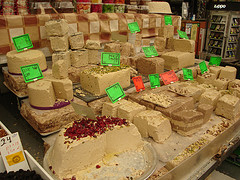
You can imagine the culture shock Iranian Jews experienced after the 1979 revolution, when many sought safety in the United States and Purim rolled around. Little of what they witnessed was recognizable. Costumes? Certainly NOT a Persian custom. Same for Mardi Gras type merrymaking. Drowning out the name of Haman during the megillah reading through a cacophony of noise? Yes, but only one of their Haman traditions. While hanging effigies of Haman in backyards and burning them was no longer widespread (I assume for reasons of political correctness), some families wrote and sang their own songs about the insidious villain. Haman aside, giving children gifts and coins was a commonplace tradition, providing Purim with an atmosphere we associate with Hanukkah. Finally, Mishloach Manot came in only one form, and it wasn't a basket full of goodies. Homemade halva (much like these Israeli varieties) presented on a plate was the Persian preference, and the most widespread symbol of Purim.
Today, Iranian Jews have successfully assimilated into the American way of life, leaving "the old country" and much of its ways behind. Last year I met a group of American-Iranian Jewish teens studying in Israel. Sadly, they barely knew about these traditions. How unfortunate in this multi-cultural age.
Hopefully this post will help bring Persia back into Purim. To make it even more authentic, take your students and children on this virtual tour of Esther and Mordechai's mausoleum. Like Jerusalem's Western Wall, it was the place Iranian Jews went to pray, cry and make special requests.
Enjoy your Persian Purim. Make it meaningful and merry at the same time.
Tile photo credit
Halva photo credit
I have been fascinated by Iranian Jewry for over eight years -- from the moment I discovered Esther and Mordechai's mausoleum while surfing the net. It is located in the Iranian city of Hamadan, also famous for its Persian carpets. The minute I landed on this Jewish tourist site I began to look at Purim in a purely Persian light. No longer did it seem a mythical tale meant for a carnival celebration. So serious is this holiday that most Jews living in Iran -- secular and religious alike -- observe the Fast of Esther. Nothing is closer to home for them than Purim, with Esther and Mordechai part of their persona.
You can imagine the culture shock Iranian Jews experienced after the 1979 revolution, when many sought safety in the United States and Purim rolled around. Little of what they witnessed was recognizable. Costumes? Certainly NOT a Persian custom. Same for Mardi Gras type merrymaking. Drowning out the name of Haman during the megillah reading through a cacophony of noise? Yes, but only one of their Haman traditions. While hanging effigies of Haman in backyards and burning them was no longer widespread (I assume for reasons of political correctness), some families wrote and sang their own songs about the insidious villain. Haman aside, giving children gifts and coins was a commonplace tradition, providing Purim with an atmosphere we associate with Hanukkah. Finally, Mishloach Manot came in only one form, and it wasn't a basket full of goodies. Homemade halva (much like these Israeli varieties) presented on a plate was the Persian preference, and the most widespread symbol of Purim.
![]() |
Today, Iranian Jews have successfully assimilated into the American way of life, leaving "the old country" and much of its ways behind. Last year I met a group of American-Iranian Jewish teens studying in Israel. Sadly, they barely knew about these traditions. How unfortunate in this multi-cultural age.
Hopefully this post will help bring Persia back into Purim. To make it even more authentic, take your students and children on this virtual tour of Esther and Mordechai's mausoleum. Like Jerusalem's Western Wall, it was the place Iranian Jews went to pray, cry and make special requests.
Enjoy your Persian Purim. Make it meaningful and merry at the same time.
Tile photo credit
Halva photo credit
Sunday, March 13, 2011
Dutch and Italian Jews Share a Haman’s Ear Custom

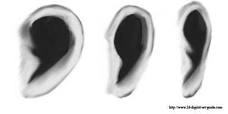
My friend Ida hails from Holland. When I told her about my research and blog dealing with Jewish holiday customs she eagerly added her own Dutch treat for Purim. “You know,” she said, “I never quite understood why Hamentashen stand for Haman’s ears. You have to go to Holland to see what a Haman’s ear really looks like.” Ida then proceeded to describe a family baking session consisting of dough dripped into a deep pan of hot, bubbling oil, carefully shaped to look like an ear. Once golden brown, it was removed, drained from oil and then sprinkled with confectioner’s sugar. Placed on a cake tray, the final display showed numerous ear shapes to choose from. “After all,” smiled Ida, “we all have different shaped ears.”
Being a pretty thorough researcher herself, Ida decided to Google the recipe. Here’s what she came up with. As you can see, the Italians share this custom as well. It’s more than a tradition. It’s an earful.
Hearty appetite and Happy Purim.
Being a pretty thorough researcher herself, Ida decided to Google the recipe. Here’s what she came up with. As you can see, the Italians share this custom as well. It’s more than a tradition. It’s an earful.
Hearty appetite and Happy Purim.
Sunday, February 27, 2011
The Jews of Alsace France have a Unique Way of Remembering Haman

Skip the Hamantashen. The Jews of Alsace France prefer to eat Hanukkah style doughnuts on Purim, and they have created their own gallows humor to remember Haman. They don’t tell Haman to hang on to his hat, but in their own way they hang him out to dry – literally. You’ve got it. They eat smoked beef that they have hung out to dry and put it in their pea soup or steamed cabbage, making it an important course in their Purim feast. It’s a fun idea and translates well if you want to turn your classroom into a Purim Deli. I can envision hanging salamis “dressed up” as Haman and his sons. It’s a delicious idea for a holiday that’s full of fun.
Enjoy!
Enjoy!
Sunday, February 20, 2011
Portuguese Jews Reach Out to the Poor on Purim

With a month to go, we’re all in the throes of getting ready for Purim – the happiest holiday on the Jewish calendar. But there’s a serious side to Purim that kids should be aware of as well, and that’s Matanot Le’Evyonim – Gifts for the Poor. Portuguese Jews make sure to bring this message home. Once the Megillah is read on Purim morning the synagogue youth leader takes youngsters on a door-to-door campaign, collecting money in velvet bags that are distributed to the less fortunate in the community. What’s more, on Purim day poor people are not ashamed to knock on the doors of their fellow Jews, asking for help. Every household has its own pile of coins ready for distribution.
Helping the underprivileged is an important Purim lesson. In between learning about the story of Esther, how about organizing a Purim Costume Drive? Ask your students to bring in last year’s costume as a donation to less fortunate kids who don’t have the means for creating a fancy getup.
What about volunteering at a local soup kitchen the day before or after your Purim festivities?
I am sure you can come up with even better ways to get the message across that it is important to reach out to the needy.
Food for thought as you start your Purim lessons.
Speaking of food for thought – I’ll be back over the next few weeks with some fun Purim food customs.
Tami
Helping the underprivileged is an important Purim lesson. In between learning about the story of Esther, how about organizing a Purim Costume Drive? Ask your students to bring in last year’s costume as a donation to less fortunate kids who don’t have the means for creating a fancy getup.
What about volunteering at a local soup kitchen the day before or after your Purim festivities?
I am sure you can come up with even better ways to get the message across that it is important to reach out to the needy.
Food for thought as you start your Purim lessons.
Speaking of food for thought – I’ll be back over the next few weeks with some fun Purim food customs.
Tami
Subscribe to:
Posts (Atom)