Showing posts with label Judaism for children Judaism holidays. Show all posts

Sunday, February 9, 2014

A Different Purim Twist from Morocco: Haman's Eyes

Haman must have been a funny looking fellow. Ears that looked like triangles, and (now I've discovered) -- eye sockets that looked like unshelled hard boiled eggs.

You guessed it. Two hard boiled eggs in their shells are the key for baking a Moroccan Purim bread called Haman's Eyes. It can be a bread adorned with almonds, like the one in this picture, used as part of the Mishloach Manot.

Or...it could resemble this!


A fun class or home activity? You bet. Just follow this recipe and give that devil everything he deserves!


Photo credit
Haman's Eyes Photo Credit

Sunday, January 19, 2014

What Are You Doing for Rosh Chodesh Adar?


Are you leaping for joy because this year is a leap year on the Jewish calendar? Have you thought about the fact that one week from this coming Friday you can start singing the Doublemint chewing gum song Double Your Pleasure, Double Your Fun...?

Yup. This year we've got the twin Adar months of Adar Aleph and Adar Bet. Since Adar is the happiest month on the Jewish calendar, that means we can double our fun. And since Purim is celebrated during Adar Bet, we have an expanded heads up for planning this joyous celebration.

But first, what do you have planned for Rosh Chodesh Adar Aleph? Don't forget, it's the prelude to your Purim festivities.

Have you thought about a combined Rosh Chodesh-Shabbat feast?
Hmmm...let's play with this idea. Originally Rosh Chodesh was an important monthly holiday. The shofar was blown, followed by family festivities -- meaning yummy food. On Shabbat we welcome the Sabbath Queen with a sumptuous meal. So, a mini Friday/Shabbat-Rosh Chodesh banquet sounds like a natural. Here are some kosher kid-friendly recipe ideas.

Next, let's welcome Rosh Chodesh Adar with a little fanfare. Blow the shofar please.

This is beginning to sound like a royal procession -- which ties in as well since Rosh Chodesh Adar falls on Friday, and on Friday nights we welcome the Sabbath Queen. Before a royal monarch enters a banquet hall trumpets are blown and a royal flag parade precedes the monarch. A flag for this year's Sabbath Rosh Chodesh Adar Queen? With a coat of arms? Have a look at this. Not only will it get you in a Rosh Chodesh Adar celebration mode, but it will also get you thinking about Purim.

All of this is just for starters. The rest is up to you. Remember: It's your Purim rehearsal and the beginning of two joyful, happy, fun months.


Rosh Chodesh Graphic Credit
Shofar Blowing Photo Credit

Sunday, November 3, 2013

Start Your Own Dreidel Collection

Here's a custom that will get your head spinning -- giving yourself a new dreidel every year.

That's what I do. I love collecting unusual dreidels, so much so that I had a carpenter make this wood case for my collection. I've opened the door so you can have a peek, but let me show you a few of my favorites.
I adore this colorful dreidel. It looks like it could be the prototype for a home/class arts and crafts project.


In our house, Shabbat Hanukkah has a special spin, thanks to this dual purpose dreidel that also serves as a spice box. 

Speaking of combinations -- this is the best! An all-in-one Hanukkiah/dreidel/Hamsa, the latter for extra luck in playing dreidel. 

Salt and pepper shakers for the festive Thanksgiving/Hanukkah meal? A little bud vase for the table as well? Have a look at the trio on the second shelf.

But the dreidel with the best and longest spin?

You got it. Nothing beats the old fashion wood models on top. Which leads me back to an arts and crafts project suggestion: this year's wood dreidel model with a painted turkey motif. 
It's bound to be a collector's item! 
Another oldie but goodie? Dreidel, Dreidel, Dreidel. Have fun listening while you make this year's model.

Monday, February 25, 2013

Bukharan Passover Seder Overture

No holiday is more colorful when it comes to customs than Passover. I thought I had covered all the customs in my book Passover Around the World, published in 2006. No way! I keep on discovering new, fascinating and fun traditions.

Today, I'm going to transport you to Bukhara, a Central Asian city located on the ancient Silk Road.  Its Jewish community claims they are descendants of the lost tribes of Naphtali and Issachar. They have a developed a tradition that I call the Passover Seder Overture. All the females tie packages of matzah to their backs. They choreograph a simple dance and sing the words (in Tajik -- the Persian dialect that is their native language) With Haste We Went Out of Egypt. What a wonderful opening act to the Seder night. Want to get a glimpse of a Bukharan Jewish song and dance? Have a look.
Want to continue the play? Read one of my earliest posts on Passover customs and you'll see that Seder night has a lot of home-made Broadway potential.

I'll be back with some more customs that will get you thinking.


Photo credit

Sunday, December 2, 2012

There's No "December Dilemma" If You Adopt & Adapt This Hanukkah Custom From Gibraltar

I will admit that the phrase "December Dilemma" is new to me. It's the type of disconnect that happens after living 35 years in Israel. I first heard it two weeks ago from a friend in Rockville, Maryland, explaining how her synagogue's sisterhood invited a speaker to talk on the topic. My initial reaction was clever copywriting, but since that conversation I've seen the phrase appear in several articles.

Gift giving seems part and parcel of the "December Dilemma." Why feel that you have to keep up with the Christmas stocking? This year give the gift of light every night by adapting a Hanukkah custom from Gibraltar.  While it calls for lighting one Menorah using wicks and oil for the entire family, the best part is reciting a different phrase every night from Tehilim that connects with light.

How does this solve the "December Dilemma?" Here are my thoughts. Let kids earn their gifts. Turn them into Bible detectives and ask them to find a different source each night using the word light. Try this for a jump start: go to the book of Genesis and Let there be light.


Want an American connection as well? That's simple and it's even Jewish.


Our lady of liberty represents a guiding light to freedom -- a wonderful tie-in to the story of the Maccabees.

And what about the famous poem connected to the Statue of Liberty?
It may not actually use the word light, but the concept is embedded in its words. The Jewish connection? Emma Lazarus, of course. While today she is famous for her poem "The New Colossus," during her lifetime she was known for her work "Songs of a Semite." It was written after experiencing a reawakening of her Jewish heritage. Something to contemplate this year while "battling" the "December Dilemma".

Happy Hanukkah!


Hanukkah Candles Photo Credit
Statue of Liberty Photo Credit

Sunday, February 26, 2012

This Purim Step, Stomp & Walk Tall

Back in the 1960's Nancy Sinatra made it big on the music scene thanks to her hit These Boots Are Made For Walking and its popular refrain: One of these days these boots are going to walk all over you.

Did she have Haman in mind when she sang this song? Sure enough one of the Purim customs I recently found is to write the name of Haman on the sole of your shoes, and stamp your feet really hard every time Haman's name is called out during the Megillah reading until his name is erased. Unfortunately, this custom was not connected to a specific country but it did remind me of a French Purim custom that I posted in 2010 in which Haman's name was either printed or engraved on 2 stones knocked together during the Megillah reading.

Contact me if you have any other creative customs for obliterating Haman's name. I'll be happy to post them.

Purim Sameach. Happy Purim.


Photo credit

Sunday, February 12, 2012

A Purely Persian Purim

Meet Queen Esther. At least that's who I'd like to think this lady is, for who else would be depicted on a 17th century tile made in Isfahan, Iran, depicting an Iranian Jewess?

I have been fascinated by Iranian Jewry for over eight years -- from the moment I discovered Esther and Mordechai's mausoleum while surfing the net. It is located in the Iranian city of Hamadan, also famous for its Persian carpets. The  minute I landed on this Jewish tourist site I began to look at Purim in a purely Persian light. No longer did it seem a mythical tale meant for a carnival celebration. So serious is this holiday that most Jews living in Iran -- secular and religious alike -- observe the Fast of Esther. Nothing is closer to home for them than Purim, with Esther and Mordechai part of their persona.

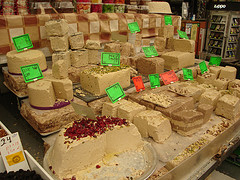
You can imagine the culture shock Iranian Jews experienced after the 1979 revolution, when many sought safety in the United States and Purim rolled around. Little of what they witnessed was recognizable. Costumes? Certainly NOT a Persian custom. Same for Mardi Gras type merrymaking. Drowning out the name of Haman during the megillah reading through a cacophony of noise? Yes, but only one of their Haman traditions. While hanging effigies of Haman in backyards and burning them was no longer widespread (I assume for reasons of political correctness), some families wrote and sang their own songs about the insidious villain. Haman aside, giving children gifts and coins was a commonplace tradition, providing Purim with an atmosphere we associate with Hanukkah. Finally, Mishloach Manot came in only one form, and it wasn't a basket full of goodies. Homemade halva (much like these Israeli varieties) presented on a plate was the Persian preference, and the most widespread symbol of Purim.


Today, Iranian Jews have successfully assimilated into the American way of life, leaving "the old country" and much of its ways behind. Last year I met a group of American-Iranian Jewish teens studying in Israel. Sadly, they barely knew about these traditions.  How unfortunate in this multi-cultural age.

Hopefully this post will help bring Persia back into Purim. To make it even more authentic, take your students and children on this virtual tour of Esther and Mordechai's mausoleum. Like Jerusalem's Western Wall, it was the place Iranian Jews went to pray, cry and make special requests.

Enjoy your Persian Purim. Make it meaningful and merry at the same time.

Tile photo credit
Halva photo credit