Thursday, April 25, 2013

The Custom of Shabbat Heirlooms

Today I had the privilege of appearing at the Melvin J. Berman Hebrew Academy in Rockville, Maryland. Using my book Lotty's Lace Tablecloth, we focused on the importance of family heirlooms -- how they connect us to our ancestors and our Jewish way of life. For starters, before reading the book I showed 4th grade students the lace doily for placing Sabbath candlesticks on, that my grandmother made as a wedding gift for my mother.

Afterwards, I asked the students to show their heirlooms and tell the tale behind them. Some wonderful stories emerged, including tales of bravery and service in the American army.

I was particularly taken by how many children brought in ritual objects related to Shabbat. It was amazing hearing about ancestors fleeing Russia (I assume pogroms) and making sure they had their precious candlesticks with them.  Some brought in the actual candlesticks, others brought photos.


A wood Havdalah spice box made in Israel during the early years of statehood was also proudly exhibited. Since I am always looking for unconventional heirlooms, I especially appreciated the Shabbat gefilte fish cleaver the girl below brought in -- and her reenactment of how her grandmother chopped the fish.


Talk about unconventional -- how about this Cantor's robe?!

Yes -- kids love heirlooms and learning the stories behind them. If you're a teacher, a Shabbat heirloom show & tell is an enriching program. If you're a parent, what better way to connect your children with their ancestors?! What's that -- you don't have a Shabbat related heirloom? It's never too late.  Start the tradition now.

Shabbat Shalom.


Thursday, April 18, 2013

A Shabbat Custom from China that Connects to Shavuot

Centuries ago The Wandering Jew made tracks to the Far East, establishing a presence in China. Happily, I've discovered some of their customs and recently found a Shabbat tradition dating back to the 18th century that could easily be applied to a 21st century Shavuot celebration.

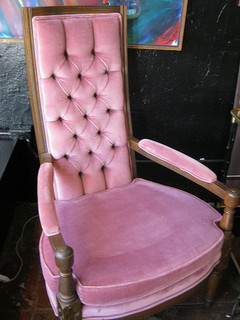
Before the Torah reading began, Chinese Jews removed the Torah from the Ahron Kodesh (Holy Ark) and put it on a special seat called the chair of Moses. From there it was carried to the Bima for the Torah reading. A small gesture but an important one, for where would we be without Moses and the Torah given to him on Mt. Sinai?

This of course is the segue to Shavuot, a holiday also referred to as Zman Matan Torateinu -- the time we received the Torah. So here's my suggestion: This Shavuot, how about designating a special chair for Moses? We already learned about a North African custom of placing an Elijah Chair in the Sukkah. Why not give Moses his due credit? Even better, how about creating your own Moses chair? You don't need wood. It seems a simple large carton will do, and you, your students and your children can write messages to Moses on it. Even better, how about the 10 Commandments? Get your creative juices going and enjoy!


 Shabbat Shalom...and Chag Sameach!


Velvet Chair Photo Credit
Carton Chair Photo Credit

Sunday, March 31, 2013

Connecting Ilan Ramon with Yom Hashoa


I'm beginning to wonder -- is the social media age distancing kids from the past? It seems that today's life is only about the here and now. During my recent trip to Houston I found out that my 22 year-old Texas cousin had no idea who were Wyatt Earp or Wild Bill Hickok. I was astounded, but he had a good answer: "Our generation is part of the space frontier." 

I shrugged my shoulders, thinking it's all part of a changing America. However, at a family seder in Long Island I met a young married woman -- a college graduate -- who never heard of Ilan Ramon and gave me a quizzical look when I mentioned the Columbia space shuttle.

She may be an isolated case; nonetheless....We are a people that believes in collective memory. It's part of our Jewish identity and should remain firmly in place. Purim teaches us to remember Amalek. Unfortunately, we've had numerous variations on that theme. Yom Hashoah is part of the pantheon. 

How does this tie in with Ilan Ramon? This year marked the 10th anniversary of the space shuttle Columbia's crash. PBS recently aired a documentary entitled "Mission of Hope". Lo and behold they brought up the remarkable story of the tiny Torah scroll which Ilan Ramon brought with him into outer space. The story of the Bar Mitzvah in the Bergen Belsen concentration camp using this Torah scroll is the tale that I researched and retold in my award-winning book "Keeping the Promise. It is the right story for this year's Yom Hashoa commemoration. It is a homage to the Jewish spirit and pays tribute to Ilan Ramon -- a hero in Israel long before his space adventure, the son of Holocaust survivors and a proud Jew who took additional Jewish and Holocaust memorabilia on board the shuttle. "Keeping the Promise" has also been translated into Hebrew and both are available through Kar-Ben. Reading the two side-by-side will enhance your Hebrew lessons, and your students' reading and speaking skills.

Wishing you a meaningful Yom Hashoah.

Tuesday, March 12, 2013

Tunisian Jews Remember Moses through an Unusual Seder Plate Custom

How many times have we heard that Moses -- the hero of our Passover story -- is never mentioned in the Hagaddah? Apparently Tunisian Jews try to rectify this situation through an unusual Seder plate custom. Instead of adorning their table with a variation of the Seder plate familiar to all of us, they use a reed basket (since I'm not sure of the size, I'll let you pick). They put all the Seder plate symbols inside the basket. Before reciting Ha Lachma Anya -- "this is the bread of affliction" --  the woman of the house takes the basket, and circles it over the head of each Seder participant while saying "we quickly left Egypt." The participants answer by reciting these words: "Yesterday we were slaves. Today we are free. This year we are here. Next year we will be free people in the land of Israel."

I think this subtle remembrance of Moses as a baby in a reed basket is brilliant. Similarly, so is the subtle reference to his mother Yocheved and sister Miriam by having the woman of the house take on this role. Finally, doesn't this custom complement the Bukharan Seder overture that I discussed two weeks ago? Start putting all the customs together that I have brought up and you have the makings of a Passover play.

Enjoy your Seder and Bravo to all the actors!
חג שמח


Sunday, March 3, 2013

Southern Italy's Anousim Personalize the Seder Plate & Add A Symbol That Can't Be "Beet"!


This past October I introduced you to the Italian Anusim (Italians whose ancestors were forced to convert to Christianity) through a Shabbat custom related to me by Rabbi Barbara Aiello. We became e-quainted after I read an article about the Rabbi, so I recently turned to her once again about unusual Passover customs. Sure enough she had one, and it can't be "beet."

In addition to the traditional Seder Plate placed at the head of the table for the Seder leader, Italian Anusim make sure that each participant has his/her own personal Seder plate. It's plain glass and all of the symbols are placed on it, plus an additional symbol that they have developed. Italian Anusim also include a bietola -- a blood red beet -- to symbolize the lamb's blood put on their doorposts by the Israelites in order to save the firstborn in each family.

This definitely is a creative twist and should get all of us thinking about something unusual to enhance this year's Seder, be it at school or at home.


Photo credit

Monday, February 25, 2013

Bukharan Passover Seder Overture

No holiday is more colorful when it comes to customs than Passover. I thought I had covered all the customs in my book Passover Around the World, published in 2006. No way! I keep on discovering new, fascinating and fun traditions.

Today, I'm going to transport you to Bukhara, a Central Asian city located on the ancient Silk Road.  Its Jewish community claims they are descendants of the lost tribes of Naphtali and Issachar. They have a developed a tradition that I call the Passover Seder Overture. All the females tie packages of matzah to their backs. They choreograph a simple dance and sing the words (in Tajik -- the Persian dialect that is their native language) With Haste We Went Out of Egypt. What a wonderful opening act to the Seder night. Want to get a glimpse of a Bukharan Jewish song and dance? Have a look.
Want to continue the play? Read one of my earliest posts on Passover customs and you'll see that Seder night has a lot of home-made Broadway potential.

I'll be back with some more customs that will get you thinking.


Photo credit

Thursday, February 14, 2013

Algerian Jews Connect Purim with Hanukkah


It's always fascinating to find out how some Jewish communities around the world connect different holidays through customs. In the past I've written about Jews in Portugal giving Purim "gelt" to their children. Now I've discovered an additional Purim custom connecting this holiday with Hanukkah. Algerian Jews have a custom of children lighting candles on Purim. Unfortunately, I don't know how many but let's assume there's one candle for every major character in the Purim story.

You're probably thinking "Cute, but how can I connect this to classroom or home activities?" Here's the answer. I've googled and there are simple candle making instructions for kids. Create different sizes and colors for each character, light them and watch them burn. I'm placing my bets on a short, red colored candle for Haman with a caption "Burn Baby, Burn."
Sound right to you?


Photo credit